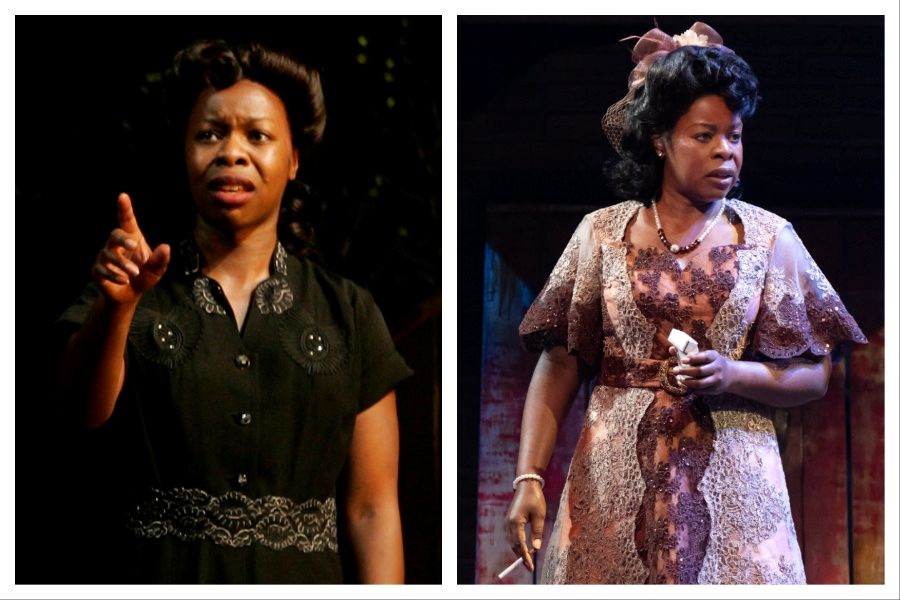
Roslyn Ruff’s face tells no lies. That’s something I’ve noticed over the many years I’ve watched and admired this powerhouse actor’s work. If her character is worried and worrisome, like the snarky Jasmine in Fairview, we can all feel it; if the woman she’s playing is weighed down with mourning and responsibility, as was the titular widow in X, or Betty Shabazz vs. the Nation, her dignified gravity is palpable. And when Louise, a middle-aged landlady in August Wilson’s Seven Guitars, now in an excellent revival at Lincoln Center Theater that opens tonight, is radiating skepticism—of one character’s youthful idealism, or another’s boastful machismo—you cut could yourself on the sharpness of Ruff’s stare.
When I asked her recently about this aspect of her work, she laughed with recognition. She recalled the time the late Lorna C. Hill, the founder of Buffalo, New York’s Ujima Company, where Ruff worked for several formative years, was giving notes one day after a rehearsal.
“She had given her spiel, and she said, ‘Now, do you understand? Are there any questions?’ You could tell that everybody was kind of afraid to speak up,” Ruff said—herself very much included. Hill’s conclusion, according to Ruff: “‘Okay, well, if I need to know whether or not you all understand, and you don’t say anything, I will just look at Roz, because her face will tell me everything I need to know.’ That was the first time I became aware of the storytelling in my facial expressions.”
There’s more to her craft than phsyiognomy, of course. And one measure of how much Ruff has grown as a performer is Seven Guitars itself: She starred as Vera, the young love interest of the musician Floyd “Schoolboy” Barton, in the 2006 Signature Theatre revival of the same play. That she is now playing Louise, Vera’s sometime confidant and landlady, is a source of no small wonder and gratitude.
“That was my first major Off-Broadway play, and my second play with Ruben, and my second August Wilson,” said Ruff, referring to director Ruben Santiago-Hudson, with whom she’d worked on Gem of the Ocean at the McCarter Theatre Center previously, and who returns to helm the new Seven Guitars (he knows the play well, having won the Tony for playing Canewell in the play’s 1996 Broadway premiere). Several folks involved in the 2006 production—from actors Lance Reddick to Charles Weldon to Signature artistic director Jim Houghton—have since died, which makes her return to this material bittersweet, she said, though she remains close with Brenda Pressley, who played Louise in that production.
Ruff conjured one particularly vivid memory of a backstage ritual from that 2006 production. Reddick, who was playing Schoolboy, “had a beautiful singing voice, and he would sing ‘Besame Mucho’ in his dressing room before the show. It became part of my preshow to listen to it, though he didn’t know that. One night he didn’t do it, and I was looking at the clock, and it was almost ‘places,’ so I walked to his dressing room and knocked. He was like, ‘What’s up?’ And I was like, ‘We need the song, man.’ His face lit up, he closed the door, and after that, he hit it every night.”
Going from the ingenue to the matron in the same play was “something that never occurred to me,” Ruff admitted. “I was Vera and I had a wonderful time, and the invitation to play Louise was a beautiful surprise. Getting to know the play from her point of view has been a humbling and very satisfying experience.”
I mentioned something Brandon Dirden once told me: that when he appeared as the young boy in Joe Turner’s Come and Gone at the Alley Theatre in Houston, another actor, Alex Allen Morris, told him, “Remember this name, August Wilson; he’s going to feed your family one day.” Indeed, like many other Black actors, Dirden has returned to Wilson’s work many times, in roles of various ages and generations, and plans to keep doing so. And while Wilson’s work unquestionably skews male, he did write his share of memorable women characters: Berniece in The Piano Lesson, Rose in Fences, Aunt Ester in Gem of the Ocean. In Seven Guitars, set in a Pittsburgh backyard in 1948, young Vera gets to deliver one of his most famous monologues, a lament to Schoolboy about how it felt when he left her for another woman:
It wasn’t nothing to you but it was something to me. To have you just up and walk out like that. What you think happened to me? Did you ever stop to ask yourself, “I wonder how Vera doing? I wonder how she feel?” I lay here every night in an empty bed. In an empty room. Where? Someplace special? Someplace where you had been? The same room you walked out of? The same bed you turned your back on? You give it up and you want it? What kind of sense does that make?
But don’t sleep on Louise’s disenchanted monologue about her ex, Henry:
That man walked out on me and that was the best thing that happened to me. When he left I told myself, say, “If you have to say hello before you can say good-bye…I ain’t got to never worry about nobody saying good-bye to me no more.” I ain’t never going through one of them good-byes again…He got to the doorway and I told him, “Leave your pistol. Don’t leave me here by myself.” He ain’t said nothing. He took out his pistol and handed it to me. I told him, say, “I ought to shoot you.” We laughed and then he kissed me good-bye. I ain’t seen him since. I got that pistol upstairs now. What I’m trying to tell you is don’t let no man use you up and then talk about he gotta go. Shoot him first.
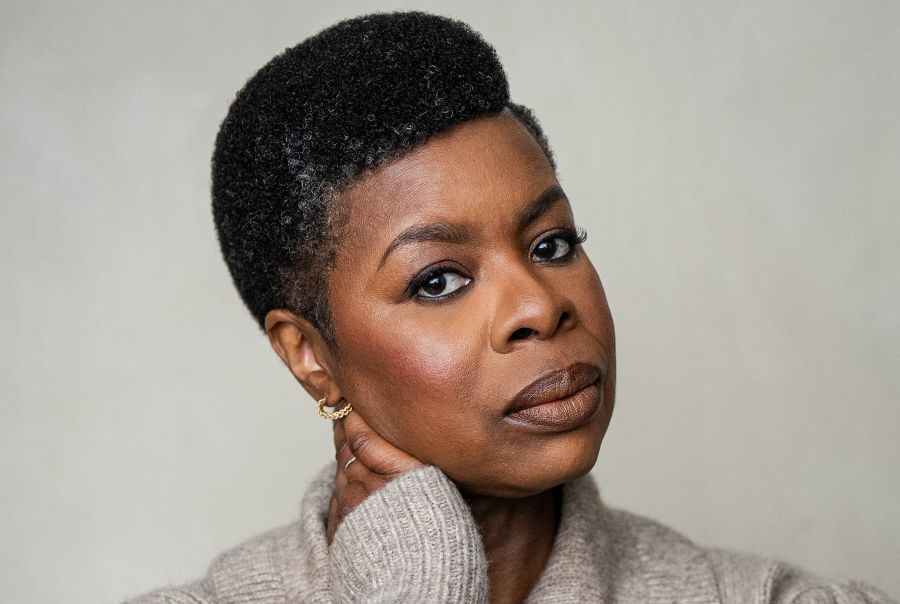
To return to the same text after all these years, Ruff said, “feels like home. It feels safe.” Part of that is due to Santiago-Hudson, who, she said, “creates such a lovely community with these shows—the way he brings the entire organization together, from the creative team, to the administration, to the box office, the facilities team, every facet of the production, so that everybody is so energized and behind it.”
Though she and he are the only two returning artists from the 2006 Seven Guitars, the rest of the cast feels like family to her for different reasons: This is her third time working with John Douglas Thompson, who plays King Hedley, and not her first working with Russell Hornsby, who plays Floyd, or Daniel J. Watts, who plays Canewell. “I have a lot of shorthand with this cast,” Ruff said. “There’s a level of familiarity and playfulness that already existed coming into the process.”
There’s another sort of homecoming feeling, and it has to do to Wilson’s unique voice.
“This work is so meaningful to me, because I know these people,” Ruff said. “I get a chance to honor my ancestors, in a way, and it just fills me up.” She’s felt this especially when family members have come to see her in Wilson’s plays. “When my father and his sister came to see me do a regional production of Piano Lesson, I remember them saying how much I reminded them of their grandmother.” When her own mother came to see the same production, she asked Ruff, “Can I come again?”
Honoring the ancestors is literally the concept behind the pointedly named character Aunt Ester, the matriarch in Gem of the Ocean, who preserves the memory and traditions of Africans on the North American continent going back to 1619. Ruff played the role of Black Mary in a production of Gem opposite Michele Shay, who originated the role of Louise in Seven Guitars on Broadway. So, it’s worth asking, is a swing at Aunt Ester in the cards for Ruff?
“You know, I wouldn’t mind dipping my toe in that,” Ruff said. “The thought of playing Aunt Ester terrifies me, and that means I need to do it—someday.”
Rob Weinert-Kendt (he/him) is the editor-in-chief of American Theatre.